February 28, 2011


February 24, 2011
Dunlop Technology for Kerala
I am ഓഫ് ലേറ്റ് seeing some "പച്ചപ്പ്" in the agriculture scenario of Kerala. Maybe in the last few years, we have been able to put across the Malayale psyche the need for more land under food crops, especially rice. In the vegetable sector too, we have paper reports of resourceful ryots harvesting handfuls of cool season vegetables like cauliflower and cabbages.
However, the average malayalee now maybe is more interested in ഭൂമി വാങ്ങി കൂട്ടി കെട്ടിട കൃഷി നടത്താന് rather than മണ്ണില് കുഴി കുത്തി ചെടി നടാന് . But there are still those മണ്ണിന്റെ മക്കള് who would like to തൂമ്പ എടുത്തു ചളിയില് പണിയാന് . കുറെ GREEN UMBRELLAs കൂടി മലയാള മണ്ണില് വിടര്ത്താന് .
എന്നാല് കണ്ടമുണ്ടങ്കിലല്ലെ ചളിയില് ഇറങ്ങാന് പറ്റൂ . എന്നാലും ചളി പോട്ടെ, കുറച്ചു മണ്ണ് മതി പൊന്നു വിളയിക്കാന് എന്ന് പോന്ന ആളുകള് ഇപ്പോഴും നമ്മുടെ ഇടയില് ഉണ്ട്. Thank GOD.
DUNLOP TECHNOLOGY
 |
| വല്ലഭനു പുല്ലും ആയുധം |
ഓടിച്ചു മട്ടമായ ടയര് നിങ്ങള് എന്ത് ചെയ്യും ? ബെസ്റ്റ് ചോദ്യം, അണ്ണാ ! ഒരു മൂലയില് തളളും, അല്ലെങ്കില് കത്തിച്ചു ഗ്ലോബല് വാര്മിങ്ങിന് ശക്തി പകരും. എന്നാല് ഇതാ....
ഉപയോഗശൂന്യമായ ടയര് (Dunlop മാത്രമല്ല, MRF, Bridgestone മുതലായവയും വിരോധമില്ല) ഒരു പ്ലാസ്റ്റിക് ഷീറ്റിന്മേല് വെച്ച് വള കൂറുള്ള മണ്ണ് നിറയ്ക്കുക. ഇതിനകത്ത് നിങ്ങളുടെ ഇഷ്ട പച്ചകറി നട്ട് വിളവെടുക്കാം. ഈ ടെക്നോളജി ടെറസില് പച്ചകറി കൃഷി ചെയ്യുന്നവര്ക്ക് പകര്ത്താന് ഉത്തമമാണ് . ടെറസിന്റെ പ്രതലത്തിനു ഒരു ചുക്കും സംഭവികില്ല എന്ന് ഈ വിദ്യ ചിട്ടപെടുത്തിയ കൃഷീ വല്ലഭന് സാക്ഷ്യപെടുത്തുന്നു. മണ്ണ് നിറക്കുമ്പോള് ടയറിനു ഉള്ളില് കൂടി ഇട്ടെന്നു ഉറപ്പു വരുത്തുക.
ഇതുപോലൊരു വിദ്യ ഞാന് ഹോര്ട്ടെനില് (നോര്വേ) കണ്ടു. പക്ഷെ ടയര് അല്ല എന്ന് മാത്രം. അവിടെ റോഡ് അരികില് പൂച്ചെടികള് നടാന് വലിയ മര കഷ്ണങ്ങള് കൂട്ടി അടിച്ചു വലിയ പൂച്ചട്ടി മാതിരി തീര്ത്തിരിക്കുന്നു.
തീര്ച്ചയായും DUNLOP TECHNOLOGY കേരളത്തിലെ ടെറസ് കൃഷിക്ക് പറ്റിയ ഒരു സാങ്ങേതിക വിദ്യ ആണ്. ഞാന് കണ്ടു ബോധ്യപെട്ടു.
 |
| ചിരിച്ചു ചിരിച്ചു വിളയിക്കാം |
ടെറസിലെ പച്ചകറി കൃഷിയില് ഒരു സഞ്ചരിക്കുന്ന വിജ്ഞാന കോശമാണ് രാജശേഖരന് നായര് എന്ന ഈ ചുറു ചുറുക്കുള്ള ഭിഷഗ്വരന് . വര്ഷങ്ങളായി വളരെ തിരക്കേറിയ പ്രൊഫഷണല് ചുമതലകള് ഇടയിലും സ്വന്തം ടെറസ് തോട്ടത്തില് അദ്ദേഹം എത്തിയിരിക്കും. ചെടികളെ പരിചരിച്ചും കീടങ്ങളെ തുരത്തിയും വിളവെടുതും ഈ അനന്തപുരി ഡോക്ടര്-കൃഷിക്കാരന് സന്തോഷിക്കും. വിവിധ തരം ജൈവ പച്ചകറികള് ഇദേഹംത്തിന്റെ ഈ തോട്ടത്തില് നമുക്ക് കാണാം കഴിയും. DUNLOP TECHNOLOGY യുടെ പേറ്റന്റ് തീര്ച്ചയായും ഈ കര്ഷകന് സ്വന്തം.
 |
| കോവലും തക്കാളിയും ഉണ്ട് ഇവിടെ |
വൈകുന്നേരങ്ങളില് രണ്ടു എണ്ണം വിട്ടു ഭക്ഷ്യ സുരക്ഷ എങ്ങിനെ നടപ്പിലാക്കാം എന്നതിനെപറ്റി വീമ്പു പറയാതെ ഈ ഭിഷഗ്വരന്റെ ടെറസില് നിന്നും നമുക്ക് ചില ഗുണ പാഠങ്ങള് പഠിച്ചുകൂടെ ?
February 9, 2011
Teak
 | ||
| The leaves of TEAK |
The leaves are arranged OPPOSITE to each other.
It can also be seen that one pair of leaves in at right angles to the pair just above or below it. This type of arrangement of leaves is known as OPPOSITE DECUSSATE.
The young stems of Teak are also quadrangular, you can feel all the four sides.
Try rubbing the younger leaves in your fingers or palm and experience a red stain!
January 30, 2011
January 28, 2011
TEAK IS OUR NATURAL MONUMENT
A 500 year old, 38.5-metre-tall teak (Tectona grandis) tree with an astounding 7.75 metre girth is a real wonder. A sight to beholden. A real natural monument. A real GREEN UMBRELLA. Kudos to its protector(s) too.
A NATIONAL MONUMENT
This tree, Teak is a real crowd puller. A few centuries back, it was this species that drew the Europeans to India . The English finally fell for its charm and plundered it for their Royal Navy. A few among the invaders however farmed it. The famous "Conolly's Plot" and "Bourdillon's Plot" are natural reminders of the durability and strength of this wonderful tree species. One can see very wonderful and very stately specimens of teak in these forests and elsewhere. In the modern era too, it remains the paragon of global timbers. In Kerala, every mallu would only be too willing to spare a few bucks to own a piece of teak furniture.
Why then are waiting to declare it as our NATURAL MONUMENT?
January 23, 2011
January 21, 2011
Sabarimala
This abode of the Lord is now in the news for the wrong reasons. Ironically, the pilgrimage has become quite of a concern from the ecological angle also.
Every forest has a carrying capacity, including the forests which cradle Sabarimala. This place, it is believed, was the domain of very ferocious animals. The presence of predators means there were also a good number of prey species. Better animal diversity signifies a vibrant ecosystem, which must also naturally include a luxuriant diversity of plant species. So, this place once had a lot of "Green Umbrellas' too. The Lord lived along with his numerous creations, big and small. And one of his creations, Man, came walking, once in a while, to pay respects to the creator.
Then, sometime back, man thought he must dominate. He must be alone. He will not walk. He must visit as and when he wished to do it. One of the very basic philosophy of Hinduism is the respect and compassion to be shown towards all of GOD's creations. By clamoring for more "development" projects, aren't we violating these tenets?
As Indians, we boast of an eco-friendly constitution too. It is our fundamental duty to protect and improve the natural environment including forests, lakes, rivers and wild life, and to have compassion for living creatures. How then does our demand for "opening" up Sabarimala fit the bill?
I don't understand. But I am sure Sabarimala has a carrying capacity and that should be respected. For the good of all of the Lord's creations.
January 11, 2011
The Minister is right again
Mr. Rameshji is speaking some very right things.....False Mindset!
Nobel Laureate Elinor Ostrom
I remember reading the hardships of Dr. Brandis. This fine forester tried to convince his English masters that co-management is the best option for Indian forestry. In the Indian context, forest is a common property resource, he argued in vain. Dr. Brandis exactly said what Nobel Laureate Elinor Ostrom said last day. How communities set their own rules and defined the rights of access to common property resources.
More than a century later, while India is exploring ways to get people involved in "joint management" of forests, Mr. Brandis might be really laughing in his grave.
- The prevailing “mindset,” that only the government can manage common property resources, was just as fallacious as the view of some NGOs that only communities can manage these resources.
- The intellectual edifice of legislation governing forests still treats those who depend on forest resources for their livelihoods as criminals.
Nobel Laureate Elinor Ostrom
- The notion that public officials were the best-equipped to resolve problems of the commons had been proven to be untrue.
- The dominant perception — that common property resources can either be managed by the government or be handed over to private interests — has been questioned.
I remember reading the hardships of Dr. Brandis. This fine forester tried to convince his English masters that co-management is the best option for Indian forestry. In the Indian context, forest is a common property resource, he argued in vain. Dr. Brandis exactly said what Nobel Laureate Elinor Ostrom said last day. How communities set their own rules and defined the rights of access to common property resources.
More than a century later, while India is exploring ways to get people involved in "joint management" of forests, Mr. Brandis might be really laughing in his grave.
January 9, 2011
Yes, Ministerji
Yes, ministerjee..I do agree with this. Biggest threat to Indian forests
I have been standing with some doubt on this issue from classrooms to classrooms! I admit that this idea that one third of India must be under forest cover has always riddled me.
We have a janatha that is not very serious in curbing its own numbers. Now liberalization has brought in growth and now people has more purchasing power. They want to consume and consume. Even consume land. What forest conservation can such consumers understand?
As foresters, it is a really challenging question that how we can keep all now available forested areas as forests? The tropical regions with its population cannot always hope to go on indefinitely with the process of keeping the lands locked up in the name of conservation.
More than our obsession with increasing the "forested" area (one of my Prof use to joke "in legal parlance, an area even without a blade of grass can be a forest area!), our focus should be on its quality and safe upkeep. Like what the minister said.
December 28, 2010
Can we cut trees?
This is a million dollar question! A debate on this can divide a society into two warring factions, as we know it. Post 1980s, this issue has been hotly debated. With the International Year of Forests a few days away, the doubts are going to be even more.
Trees are planted for various end uses or purposes. We plant a tree with a very green and broad canopy for shade. Plant a fruit tree species and you can harvest fruits. Some trees are planted only for timber. Like Teak or Mahogany. So every tree planting has got an objective/purpose.
Like every living thing, the tree also has got a life span. That means it begins its life as a seedling, then matures to a sapling, then becomes a pole, then a sub adult and finally a full grown adult. Then it has to die. The years a tree takes to go through these stages varies from species to species. But yes, extinction is a biological reality. Trees also face diseases and finally death. They also die. Like us.
Now the question is "Can we cut trees"? Yes, ofcourse. After it has outlived its purpose and is now in a stage where its continued existence will pose a danger to life and property. This is a straight case.
However, there are situations when we may have to cut down a tree even when it has not reached the final days. Like for example, a road widening project or a new building project. Even then, a final decision to cut the tree must be taken if all other options like pruning its branches is not a viable option. Remember, unlike animals, a plant (tree is a plant!) can reproduce its lost organs. For eg, if you cut a branch, it will create a new one!
Examine all the options before arriving at a decsion to cut. But always, plant a new tree seedling.
December 12, 2010
December 8, 2010
Plants in cupboards
plant taxonomists, let us try
Yes, in my collections too, there are some which are awaiting identification for some time now!
Yes, in my collections too, there are some which are awaiting identification for some time now!
November 7, 2010
go soft with honking!
Well, I had written about this before. In India, where it is a battle between "cattle, cars and humans",I have to be really crazy to ask for a ban on honking! No where else (maybe) can you see the post 'Sound Horn" which is there on the back of all the big ones in the Indian road. It has to be here, but I did not see any such posts in the Volvos, Mann and Scanias. No, they did not display this.
But cant we make more eco-friendly auto horns? Or atleast, why cant we choose horns which don't produce that squeaky, ear-piercing (some say it is "musical"! Bap re) horns that is deliberately picked to "terrorize" and "chase" the other motorists? I am sure we have the sound norms. Is it because that we don't know (or we just don't bother to care) that sound when used carelessly is a great polluter? Believe me, I did not hear even a single horn during my entire stint in Europe. I have to say that majority of our drivers derive great pleasure (!) in honking. This is maniacal and dangerous!
In India, as things stand now, we can honk and we must. But let us use horns which are more soft and let us learn to use it with more discretion. If we really wish to take our hands of the horn, we must first discipline ourselves and stick to the basic rules of driving. Say no to rash driving which includes not overtaking through the wrong side, jumping lanes, irresponsible overtaking and slowing/stopping at pedestrian crossings! What wishful thinking, yeah?
Sound pollution from auto honking is really bad. The humans, flora and fauna are really sick about it. Plants may respond favourably or unfavourably to sound. Some trees like Ficus religiosa are planted to cut down noise pollution. However, all life forms are distracted by the heavy and indiscriminate noise. The earthly forms, like us get disturbed by sound. So, let us go soft on honking. Let us live more responsibly.
September 23, 2010
trees of Horten, Vestfold, Norway
 |
down...... The live fences |
 |
| The majestic Aesculus |
 |
| Oh..what an Oak |
 |
| Beautiful and majestic........ |
September 22, 2010
a Viscum in Vestfold, Norway
 |
| Viscum sp (?) in a maple in Horten sentrum |
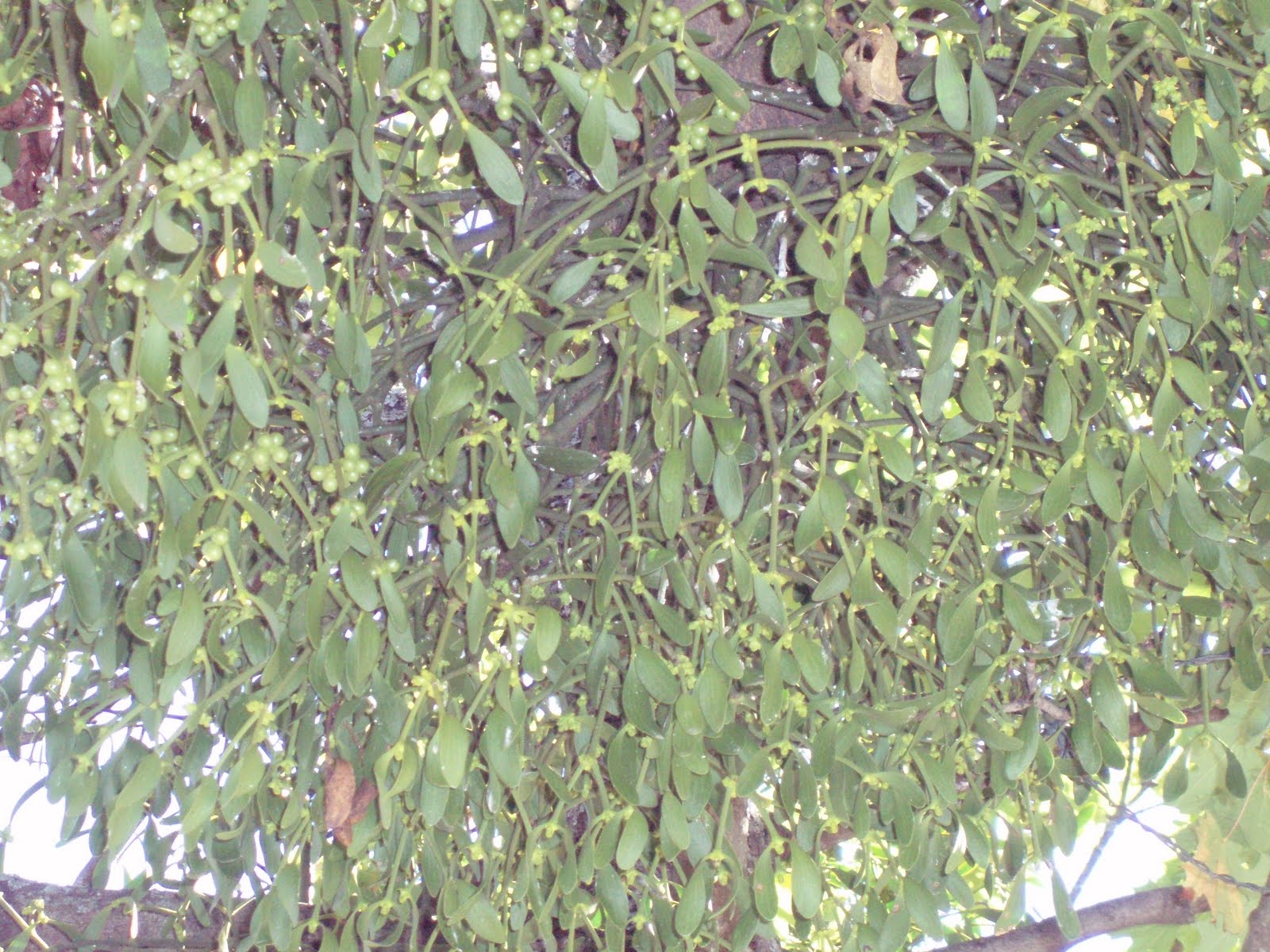 |
| The 'parasite' in a more closer range |
 |
| A more closer shot |
September 21, 2010
In Uppsala with Prof. Liden in Linn Hammarby
Miles away I am thankful to my late Prof. LCB for engineering this trip. He threw open a really wonderful path for me. Alas he is not there today. I can imagine how enthusiastically you would had welcomed my pilgrimage to the Linnaen sites. Miss you, Sir.

Another professor, who with equal enthusiasm and spirit welcomed my interest and desire to vist the Uppsala heritage sites was Prof. Magnus Liden of Uppsala University. Since the days of my Linnaeus ecourse, I had nourised a secret dream to visit this place. But never in my wildest dreams did I expect that I would receive one of the most memorable welcomes in my professional life.
Prof. Liden is a natural plant taxonomist. Devoid of any trappings, he was very easy going & knowledgeable. More importantly he was ready to explain and took pains to show me all that is worth seeing for me around in his own car. He took me everywhere, the museums, the gardens, the Hammarby. Thank you so much, Prof. Liden. Yes, I will come again to see the cathedral we missed.
Not at all forgetting Mr. Abdulla, the young Turkish botanist who was with us. I am sure he is soon going to make a name for himself in Ankara. Good luck, young man. One day I will visit your garden.
How can I miss to thank my dear sister-in-law and her sister (Yup, my wife) for leading from the front and making this trip a memorable one for me? Thank you so much.
Ya, behind every successful man there is a woman (so said an idiot)

In the Linn Hammarby, his summer house-cum-lecture halls
Another professor, who with equal enthusiasm and spirit welcomed my interest and desire to vist the Uppsala heritage sites was Prof. Magnus Liden of Uppsala University. Since the days of my Linnaeus ecourse, I had nourised a secret dream to visit this place. But never in my wildest dreams did I expect that I would receive one of the most memorable welcomes in my professional life.
 |
| Prof. Liden explaining the theme plant of the first paper of Linn |
Not at all forgetting Mr. Abdulla, the young Turkish botanist who was with us. I am sure he is soon going to make a name for himself in Ankara. Good luck, young man. One day I will visit your garden.
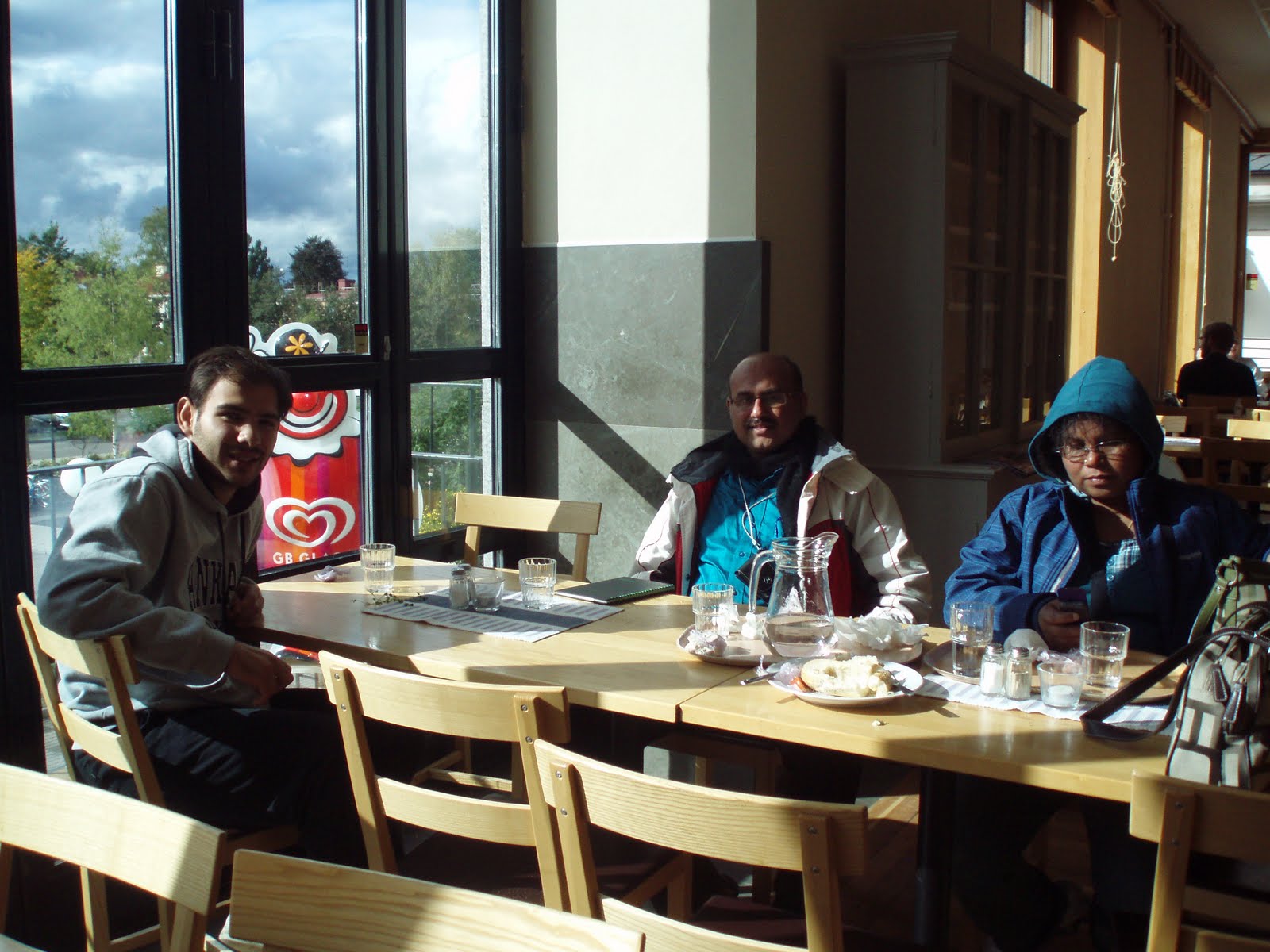 |
| Hi Abdulla...Thank U |
Ya, behind every successful man there is a woman (so said an idiot)
September 19, 2010
the red maple of Stockholm
 |
| The motif and the orginal..dont miss the fruits |
Walking down Stockholm I bumped into a maple tree. Be it Stockholm, Oslo or Horten, there are lot of trees in these scandinavian cities. Enthusiastically eyeing the morphology, I was led into another strange discovery. A flag flurting atop it. What a strange coincidence.........The motif and its original underneath it........By the by, dont miss the winged fruits-botanically 'samaras' (they here also call these fruits a 'key' 'spinning jenny'etc)- in the picture of the tree posted above.
I browsed and found out that there are about 125 species of maple trees in the temperate zone of the northern hemisphere. Maple leaves are lobed, small and oppositely placed. They change colour during the autmn or fall season. The trees here have started to change their leaf colour.
The motif in Canadian flag is the leaf of Red Maple, Acer rubrum. Though having very low timber value, red maple is used for the production of maple syrup. It is edible and of use in confectionary. The primary use is in landscaping.

September 16, 2010
Carl Linnaeus and me
Wow....at Uppsala, Sweden today visiting the Linnaeus Hammarby, Garden and Musuem....I dont know how to thank Prof. Magnus Liden and Mr. Abdulla. Thank you so much.
What a pilgrimage was this visit of mine?......Memorable. Truly enchanting and will live as long as my memory will stay with me. Visiting the very place where this astonishing naturalist worked, lived, planted and finally breathed his last. His apple tree is still there!
More pics and write ups when I get back to Horten from here..Stockholm...
Subscribe to:
Posts (Atom)